

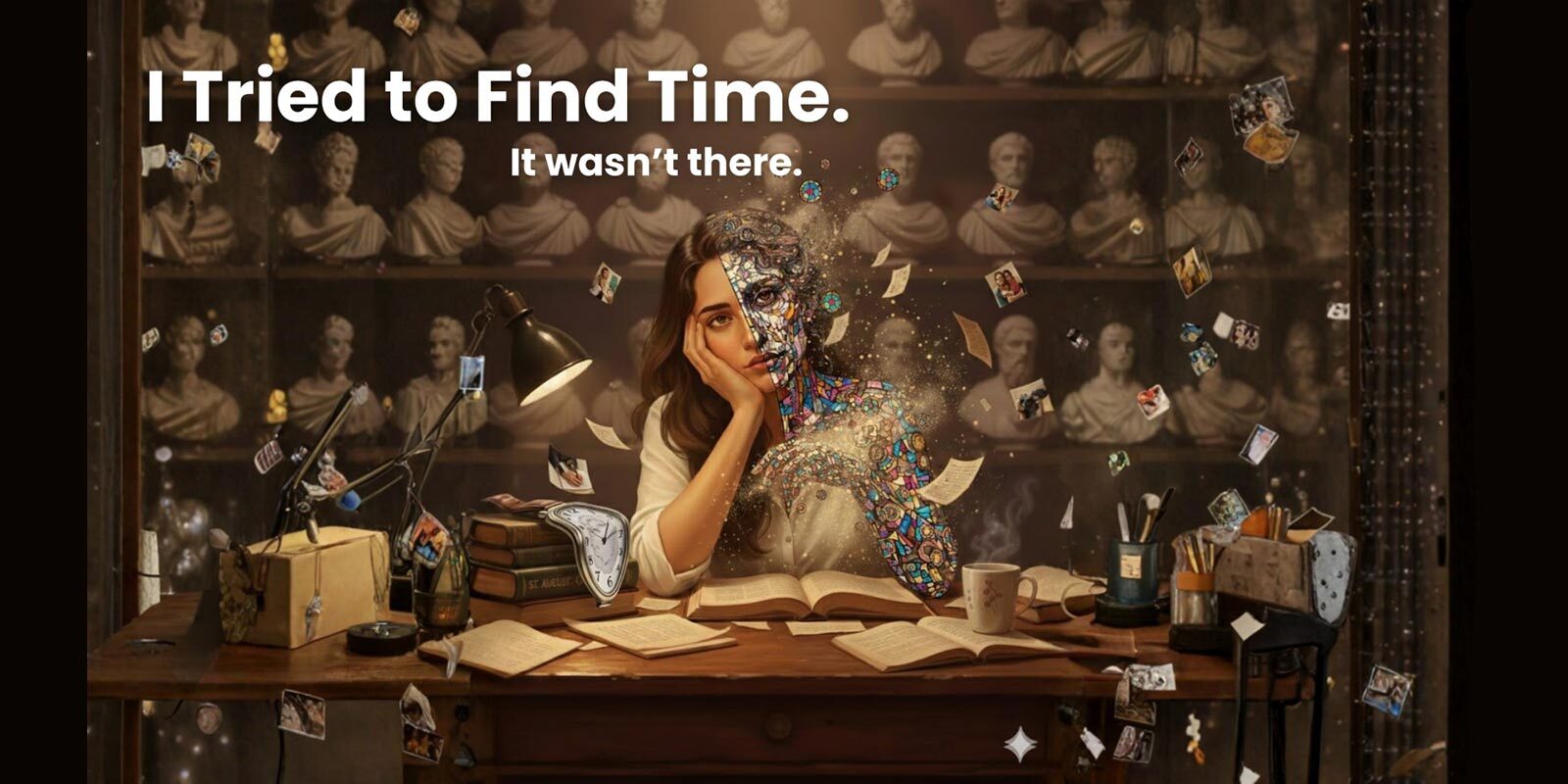
I Tried to Find Time. It Wasn’t There.
Time has been on my mind lately.
I’m a philosopher at heart. My college years often looked like sitting in a room at 3am – papers strewn across the floor – having just read something on disillusionment and collectively given up on the exam we were meant to be preparing for (since it wasn’t reality after all). A front door that was never unlocked as long as we were home, with people flowing in and out like waves. People, with whom conversation has always felt like being seen. Life, as we knew it, was discussed seriously and with abandon. Time always crept into those conversations.
I texted my mentor just a week ago about a book I’ve been writing. ‘I’m unable to find time’ I told him. The Master NLP Practitioner in me immediately texted right after – ‘my text presupposes time is lost’. My internal monologue sighed. Great job Chhavi. You have found the problem, but now what?
And so, I’ve been thinking: ‘what an odd thing for me to say!’. Where IS time lost? My magical ability to misplace things seems to have reached the metaphysical world. So, I did some thinking. An Enid Blyton book (yes, my academic references are stellar) once suggested there’s a time fairy – one who makes experiences feel faster when you’re enjoying them and unbearably slow when you’re not. This checks out according to me. A day with childhood friends disappears in a blink. Waiting for that text can feel eternal.
But then this begs the question – do I want my experiences to go slower – or faster? If everything is a blink – how do I savour it? And if things are slow – then as per the Enid logic – I’m not enjoying it. It seemed like I’m at a conundrum. As St Augstine put it rather eloquently 1600 years ago – ‘What then is time? If no one asks me – I know; if I want to explain it to a questioner, I do not know.
What is it about time – a concept SO deeply woven into our reality, something we claim to experience every day, and yet – something no one has been able to definitively explain for centuries?
So – I did some research. In the midst of Einstein’s relativity, space time continuums, quantum physics (and other subjects I understand 100% fully deeply but to save you the bother I am not explaining) – I landed on something I liked.
Time essentially – does not exist. You exist. I exist. If you and I hang out – that’s an event. It doesn’t exist – it just HAPPENS. Things can exist, and things can happen. They are not the same. This felt clear, and right to me.
Circling back to my original conundrum – can I lose something that does not exist? No I cannot. But saying so is easier. It takes away my accountability, my ownership and it’s easier to blame time for always running away. It’s far more humbling to accept that what happens – is on ME. I CHOOSE what happens. I chose to prioritise other things, work that seems urgent, social events that feel essential. Those are things that are happening, and because only I exist (not time), I am to blame to not make happen the writing of the book. Wow.
Rocket science? No. Basic? A little. Profound – surprisingly yes!!
I’ve designed and delivered learning interventions on ‘time management’ (I hate this phrase, because we cannot manage time, which is what I always open with) for years, always approaching it from a philosophical lens. My inner Jean-Paul Sartre fangirl reliably shows up – talking about choice, ownership, and meaning-making. These are things I know. And yet, somewhere between a busy calendar and a full life, I forgot to live them.
Time isn’t something we need to manage. It isn’t something slipping through our fingers. Something we’re losing. It’s simply the sum of what we allow to happen.
This isn’t just about my procrastination on finishing writing a book. This is a pattern that shows up in homes, at work and in our relationships. Teams say they don’t have time for reflection, leaders say they don’t have time for difficult conversations, cultures say they don’t have time for change. Partners say they don’t have time for romantic gestures anymore, parents and children quibble over the things that matter to them. Yet what’s really happening is prioritisation – often unconscious, often unexamined.
Leadership, then – not as a role or a job title, but as a way of being – has very little to do with managing time better. It’s about having the honesty to name what we are choosing to make happen, and the courage to choose differently when the cost becomes visible.
A lot of us have been asking the wrong question. It isn’t where did the time go? It’s what did I choose to let happen instead?
Time doesn’t ask anything of us. It doesn’t rush us, judge us, or withhold itself. It simply holds whatever we place inside it. And maybe that’s the part worth sitting with – not as a strategy or a system, but as a mirror. Because what keeps happening in our lives is rarely accidental. It’s usually rehearsed. Repeated. Protected. As soon as we realise this – we recover something far more valuable than hours on a clock.
We recover agency.
And from there, different choices can finally begin to happen.
 Chhavi is a Facilitator and Learning Program Designer who works across human behaviour, learning science, philosophy, neuroscience and psychology to design interventions that create measurable behavioural shift – not just insight. Her work integrates multiple lenses and disciplines to identify root behavioural drivers rather than surface-level skill gaps.
A strong focus of her work lies in impact and learning transfer. Trained in LTEM-based learning evaluation, she designs programs with measurement built in from the start and has developed a learner-facing evaluation model that enables participants to track and apply learning in real time. Alongside her work with organisations, Chhavi speaks at professional forums on topics such as body language and leadership, has delivered guest lectures at Jindal Global Law School, and is known for bringing learning into real, lived contexts. She is currently associated with Syngrity as a Facilitator and Learning Program Designer.