

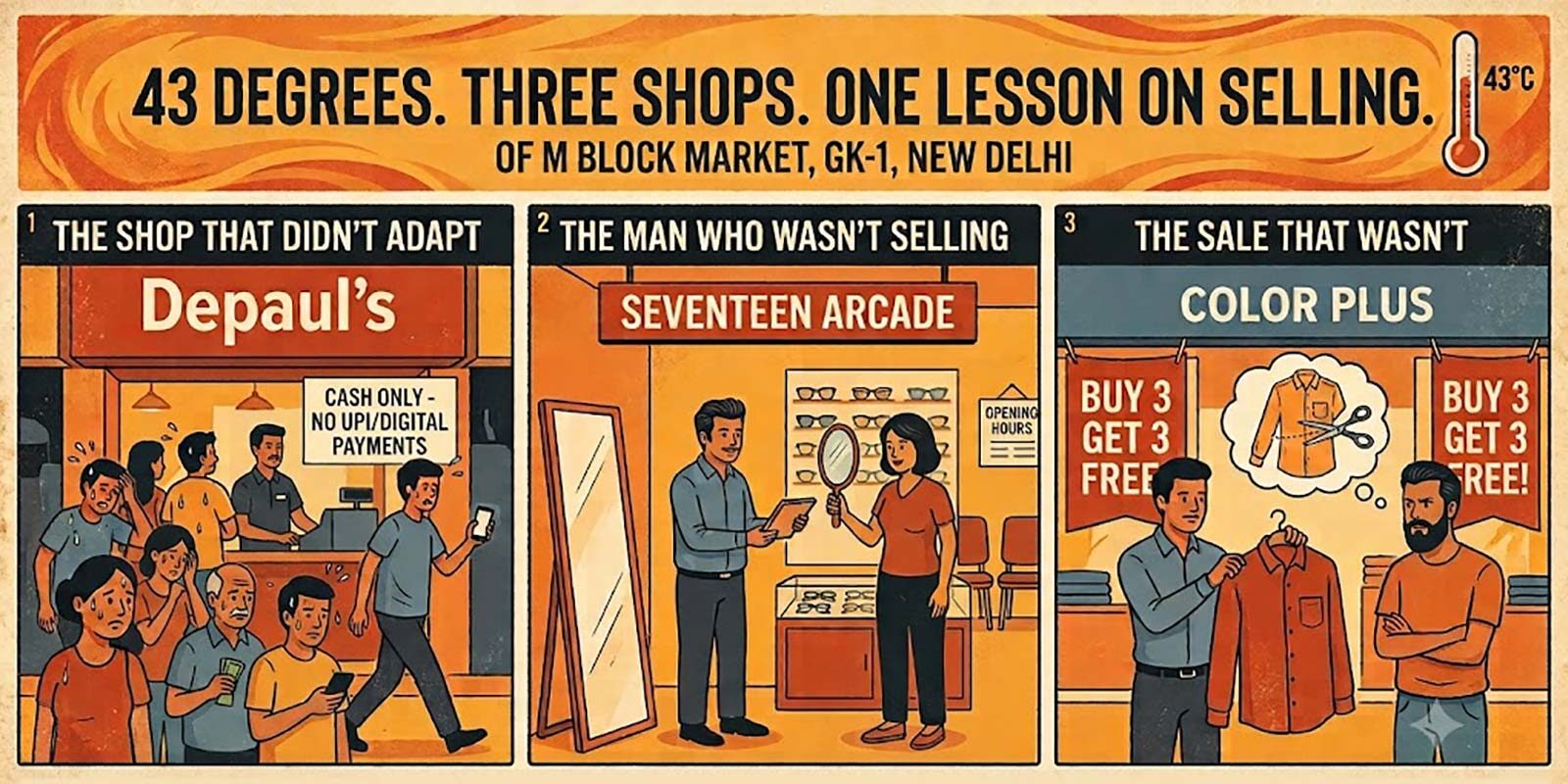
43 Degrees, Three Shops, One Lesson on Selling
Some of the best lessons in business don’t come from boardrooms or case studies — they come from an ordinary afternoon, in punishing heat, running errands, you’d rather not be running. That’s exactly what happened to me over the weekend. What began as a lazy Sunday turned into a walking masterclass on what selling really means — and what it doesn’t.
The sample size was tiny: three shops. The conditions were perfect for human behavior to reveal itself: 43 degrees. M Block Market, GK-1. New Delhi. The kind of heat where you question every life decision that brought you outdoors. And then the market became a classroom.
Act 1: The Shops That Didn’t Realize They Were Selling
Scene 1: Depaul’s
For those who grew up coming to Delhi in the 80s, Depaul’s wasn’t just a cold coffee place. It was part of the summer vacation itinerary. Visit relatives. Eat too much. Go to Janpath. Drink Depaul’s coffee.
About twenty-five years back, they opened in GK-1, M Block Market — practically my backyard after I moved to Delhi in 1996.
So, there we were yesterday. Noon. Sweating through our existence. “Do you have cold coffee?” The response was so cold that, for a brief second, I wished it could be bottled and served. “No.” Fair enough.
An hour later, we returned. Now they had coffee. Progress. Except they wouldn’t sell it because they don’t accept UPI payments. Apparently, the owner has decided that cash remains civilization’s highest achievement. We suggested alternatives. Could we transfer the money to someone? Could an employee accept it and settle later? Could there be… any solution? No. Not rude. Just immovable. We walked away exactly the way we had come in. Hot. Thirsty. And now slightly irritated.
Some businesses lose customers because they don’t have demand. Others because they don’t have flexibility.
Act 2: The Man Who Wasn’t Selling Glasses
Scene 2: Seventeen Arcade
Then came Kamran. His family has run Seventeen Arcade for decades. Over the years we’ve spent more time discussing travels and why I look for certain kinds of sunglasses. He has become my default destination whenever I decide to invest in a pair.
Yesterday, though, he wasn’t selling to me. He was selling reading glasses to my friend.
Actually, that’s not true.
He wasn’t selling reading glasses either. He was helping someone discover what looked like them and brought out their personality.
She needed reading glasses delivered within thirty minutes because she had a flight in four hours. That’s what convinced her to step into 43-degree Delhi in the first place.
Frame after frame emerged.
It reminded me of cloth merchants in the 80s. Entire bolts of fabric would be unfolded across the counter. Nobody rushed. Not the buyer. Not the seller. Choosing was part of the ritual. Kamran did exactly that. Patient. Present. Listening to what she said.
More importantly, listening to what she didn’t. After half an hour, a shortlist emerged. Then her eyes wandered towards the branded section. Interestingly, Kamran never once announced a brand name. Never pushed. Never upgraded. He simply asked her to walk over to the full-length mirror. “Go see yourself.” Because he understood something. People don’t buy frames. They buy versions of themselves. Watching her try different pairs, I was also reminded how much research premium brands put into face geometry and fit. The copies imitate the design. But they remain copies, for a reason.
When it came time to pay, Kamran pulled off what magicians would call misdirection. The discount appeared to come because of my three-decade association with him. Whether planned or spontaneous didn’t matter. Everyone walked away feeling good. The purchase felt earned. Not extracted.
Act 3: The Sale That Wasn’t
Scene 3: Color Plus
The store had giant signs announcing: Buy Three. Get Three Free. I entered wanting one formal shirt. Everything else would have been indulgence. The salesman showed me one that fit beautifully. “I’ll take it.” “Oh, sir… this one isn’t part of the sale.” Fine. Need beats discount.
Then I asked to see linen shirts. Nice collection. But as soon as I liked something, I was told that it was not on sale. Then came the masterpiece. He suggested I buy a full-sleeve linen shirt that was on sale… …and simply get the sleeves cut off. That’s not innovation. That’s jugaad wearing a name tag. Full-sleeve and half-sleeve shirts are designed differently. They drape differently. They balance differently. A tailor isn’t a magic wand. I politely declined.
While they were billing my shirt, I asked the salesman and his manager whether they were open to a learning conversation based on something I had observed. Both said yes. The salesman couldn’t quite see beyond the fact that he managed a sale. The manager could. He immediately recognized the gap — in communication, ownership and understanding the customer’s buying journey. We smiled. I paid. I left. One shirt richer. One observation richer too.
The Moral of the Walk
Three shops.
Three transactions.
Three completely different experiences.
One refused to adapt. One never appeared to be selling yet sold beautifully. One had products, offers and discounts — but couldn’t connect the dots.
In 43-degrees of heat, every interaction leaves a taste in your mouth.
Cold coffee you couldn’t buy. Glasses that made someone smile. A shirt that came with an unsolicited lesson in sleeve alteration.
Selling has never really been about the product. It’s about reducing friction. Creating trust. And making people feel just a little better walking out than they did walking in. Yesterday, only one shop truly understood that.
The next time you’re on either side of a counter — selling or buying — it’s worth asking: which of these three shops are you?
 Vikram Badhwar, CEO, Syngrity, is a communications coach, an experiential educator, and an artist trying to bridge the gap between the creative and the analytical side of our brain. He consults individuals and teams in the space of learning & development to enable transformations at a personal, professional and organizational level.